

TL;DR · Direct answer
The buying decision in brief
A clinic beauty equipment room-readiness checklist should tie one proposed model and configuration to the actual room, utilities, delivery route and handover plan. Record each requirement’s source, owner, review date and status. If power, ventilation, water, access, receiving, installation, training or acceptance responsibility is unclear, pause the affected step and obtain written confirmation before delivery or routine use.
01 / Buying guide
Open one dated readiness record for the room and proposed equipment
Start with a bounded review object: clinic site, room name or reference, target model, proposed configuration, destination market, expected delivery form, room owner and review date. The record should name the source of each requirement—current model instruction, written supplier response, facility drawing, electrician, building manager or another qualified reviewer. Do not merge these sources into a single “ready” checkbox.
Separate observed conditions from required conditions. “Two wall outlets are visible” is an observation; it does not confirm voltage, frequency, circuit capacity, grounding, connection type or suitability for the proposed machine. “Door appears wide enough” is also an observation until the packed dimensions, clear opening, route turns, lift limits and handling method are compared. Mark assumptions as open, give them an owner and set the decision that depends on them.
- Room, site and project reference
- Target model, configuration and destination market
- Requirement, observed condition and evidence source
- Room owner, reviewer, date and open-item owner
- Decision blocked and written confirmation needed
02 / Buying guide
Check power, ventilation, water and working space from model-specific sources
Build a utilities table with separate rows for electrical supply, plug or fixed connection, grounding or protective arrangements, ventilation and cooling, water quality or fill method, drainage, network, environmental limits and any other stated service. Populate a requirement only from the current source for the exact proposed configuration. A category page, another model or a similar cabinet cannot fill a missing value.
Walk the room with the people responsible for facilities and operations. Record the usable equipment footprint, operator path, cleaning access, ventilation openings, service-panel access, hose or cable routing, nearby wet areas, storage and emergency circulation. OSHA’s US electrical rules illustrate why suitability, unobstructed ventilation and working space matter, but local requirements and manufacturer instructions decide what applies. Do not convert a general rule into a universal room dimension.
03 / Buying guide
Measure the delivery route and prepare receiving before freight moves
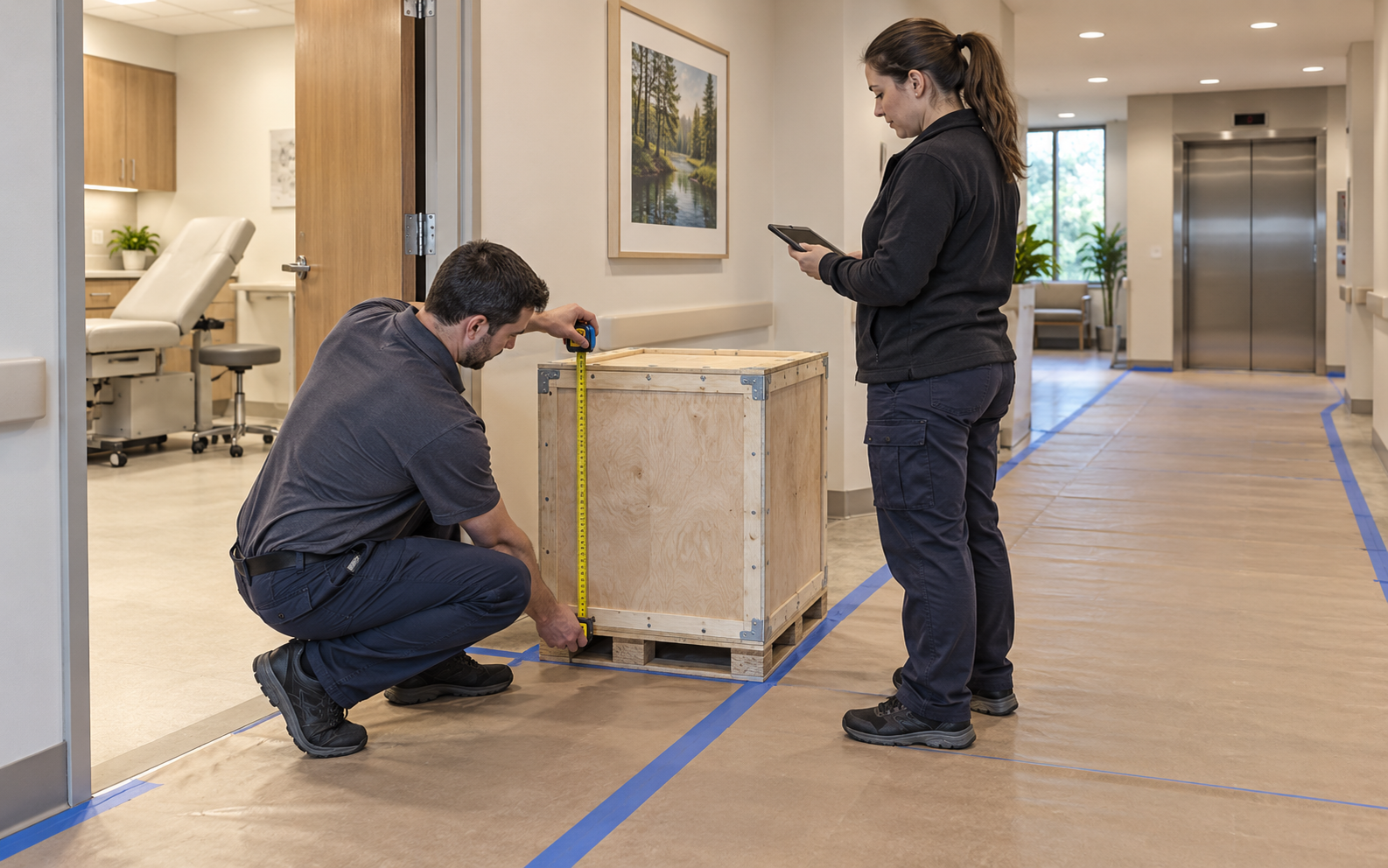
Trace the route from vehicle arrival to final position: booking or security process, unloading point, loading dock, threshold, door clear opening, corridor width, tight turns, ramp, lift doorway and rated capacity, floor protection, ceiling obstructions, staging area and temporary storage. Use the packed weight and dimensions when supplied, because an unpacked machine photograph cannot establish whether its crate can pass through the route.
Name the delivery-day roles before scheduling. Someone must confirm the appointment and route, receive the shipment, preserve external-condition evidence, compare package count, authorize unpacking and record discrepancies. Keep safe handling and lifting with the responsible logistics or facility professionals. If the route, handling method, storage condition or receiving authority is unresolved, pause the delivery arrangement rather than relying on an on-site improvisation.

04 / Buying guide
Match the configuration, then separate installation from handover
At receiving, compare the base unit, visible model identity, handpieces, accessories, protective items, consumables and supplied documents with the approved purchase baseline. Record external condition and any count or identity difference before items are dispersed. Do not connect or substitute a similar-looking handpiece to make the set appear complete; isolate the discrepancy and obtain the responsible party’s written explanation.
Then give delivery, installation, commissioning or acceptance, operator orientation or training, documentation transfer and operational handover their own rows. For each row, state who performs it, who witnesses or accepts it, what evidence closes it and what remains outside scope. A delivered crate is not an installed system; power-on is not proof of acceptance; attendance is not proof of competency; and a verbal explanation is not a durable handover file.
05 / Buying guide
Use a written pause rule for unclear site conditions
Define the pause rule before a delivery slot is booked. A field becomes blocking when it can affect safe access, required utilities, configuration identity, the agreed installation method, acceptance or the ability to complete the handover. Record the requirement, current evidence, missing answer, activity on hold, responsible person and the source that can close it. “Supplier to confirm” is incomplete unless the request names the exact model, configuration and question.
The rule should also prevent informal workarounds from becoming the accepted baseline. An extension lead, temporary water arrangement, narrower unpacked route, substituted handpiece or rescheduled training audience may change responsibilities or introduce another review. Keep the original condition and the proposed resolution as separate entries. Only the named owner should release the affected step after written confirmation and any required local professional review.
- Requirement and evidence source
- Observed condition and unresolved difference
- Delivery, installation or handover step on hold
- Named decision owner and due point
- Written resolution and release date
06 / Buying guide
Leave the room owner with a usable handover file
The handover file should let the clinic identify what arrived and where to find the current records without exposing private correspondence publicly. Include the purchase baseline, receiving record, model or serial reference when available, accepted configuration, current manual and document versions, training or orientation record as agreed, routine care source, consumable references supplied, support contact route and every open item with an owner.
Date the file and name the clinic role responsible for maintaining it. If the room, electrical supply, software, handpiece set or other configuration later changes, reopen the relevant readiness fields rather than assuming the first review still applies. The file is an operational control record; it is not a product approval, training credential, warranty promise or authorization to use equipment outside qualified instructions and local requirements.
Comparison visual
Room-readiness evidence: observation versus decision-ready record
Electrical supply
An outlet is present in the room
Exact requirement source, measured or professionally confirmed site condition, date and responsible reviewer
Delivery access
The console looks narrower than the door
Packed dimensions, clear openings, turns, lift/staging constraints, handling owner and route evidence
Utilities and space
Similar equipment normally needs no water or clearance
Current model/configuration instruction matched to ventilation, water, drainage and working-space observations
Handover
Supplier will “install and train”
Written stages, scope, owner, attendees, acceptance evidence, exclusions and open questions
Decision flow
Room readiness to handover: a controlled sequence
- 01
Define
Name the room, target model/configuration, market, owner and evidence sources.
- 02
Verify
Check utilities, operating space and the packed delivery route against current requirements.
- 03
Receive
Document condition and match equipment, handpieces, accessories, consumables and files.
- 04
Hand over
Close installation, acceptance, training and record-transfer rows separately.
Practical table
Reusable clinic room-readiness record
Each checklist row shows every comparison field.
| Field | What to record | Hold point / owner |
|---|---|---|
| Room and equipment baseline | Site, room, target model, configuration, market and review date | Room owner confirms the review object |
| Power and environment | Requirement source; site condition; voltage/frequency/connection, ventilation or other stated limits | Qualified facility owner closes every mismatch |
| Water, drainage and network | Required/not required/pending, specification source and connection location | Do not infer from another model |
| Delivery route | Packed dimensions/weight when supplied, openings, turns, lift, staging and protection | Logistics/facility owner signs off route |
| Receiving configuration | Base unit, handpieces, accessories, consumables, visible identity, condition and count | Receiver isolates discrepancies |
| Installation and acceptance | Performer, witness, tests or records, completion status and exceptions | Named acceptance owner releases the stage |
| Training and handover | Audience, scope, materials, document versions, contacts and unresolved items | Operations owner records completion or hold |
Buyer FAQ
Frequently asked questions
What should a clinic room-readiness checklist include?
Include the exact proposed model and configuration, room reference, electrical and environmental requirements, ventilation, water or drainage where applicable, usable space, packed delivery route, receiving roles, installation and acceptance scope, training and handover records. Give every requirement a source, owner, review date and status.
Can a clinic use generic power or room requirements for similar equipment?
No. Use the current instructions or written response for the exact proposed model and configuration, then have the responsible facility professional confirm the site condition. A related model, category page, photograph or visible outlet cannot supply a missing electrical, cooling, water or clearance requirement.
When should delivery or installation be paused?
Pause the affected step when a critical site condition, access constraint, configuration mismatch, safety responsibility, acceptance method or handover owner is unresolved. Record the evidence, person responsible and written decision needed. Resume only after the responsible parties close or explicitly control the open item.
Is delivery the same as installation and acceptance?
No. Delivery places the shipment at the site; installation prepares the equipment according to the agreed scope; acceptance records whether the defined checks are complete; training addresses the named audience; and handover transfers the approved configuration, documents, contacts and open items to operations.
Source notes
References and further reading
External references provide general regulatory or industry context; they do not establish approval of a listed product. Accessed 4 October 2026.
Turn the room review into a site-specific quotation request
Send the target model, proposed configuration, room and delivery information, destination market and required handover scope. Ask that every unresolved site or responsibility field be answered against that purchase baseline.
Request a quotation →