
TL;DR · Direct answer
The buying decision in brief
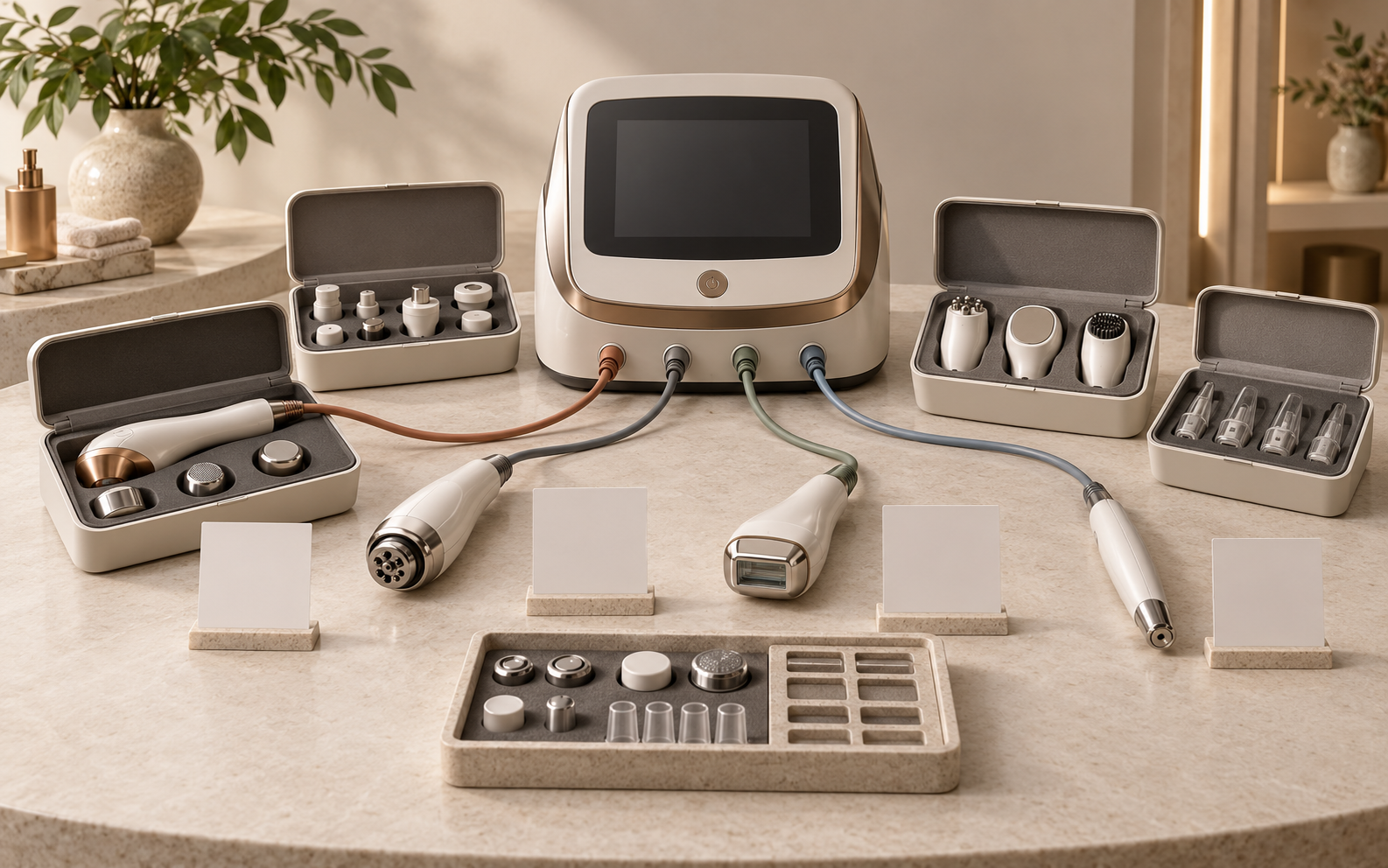
Map a multi-platform beauty device as a versioned chain: base unit → source → module → handpiece → tip or consumable. For every link, record the supplier source, model or revision, target market, inclusion status, evidence and owner. Never infer compatibility from appearance, a connector that seems to fit or a shared family name; unresolved relationships stay on hold until confirmed in writing.
01 / Buying guide
Create a base-unit record before counting functions or handpieces
Open one record for the console actually proposed in the quotation. Capture the full model or supplier reference, hardware revision when provided, software or interface version where relevant, electrical option, target market, commercial source, quotation date and configuration owner. Keep the platform family name as a search aid, not as proof that every advertised module belongs to this offer.
Give the record a baseline version and status. A distributor may receive a brochure, demonstration photo and price list at different times; each can describe a different generation or bundle. Preserve the original files and state which one controls the proposed purchase. If the seller substitutes another base unit, open a new candidate row or revision instead of editing the original identity until the differences disappear.
- Base unit, full model and supplier reference
- Hardware, software or interface revision when provided
- Target market, buyer project and quotation source
- Configuration owner, review date and baseline status
- Open identity, document or market question
02 / Buying guide
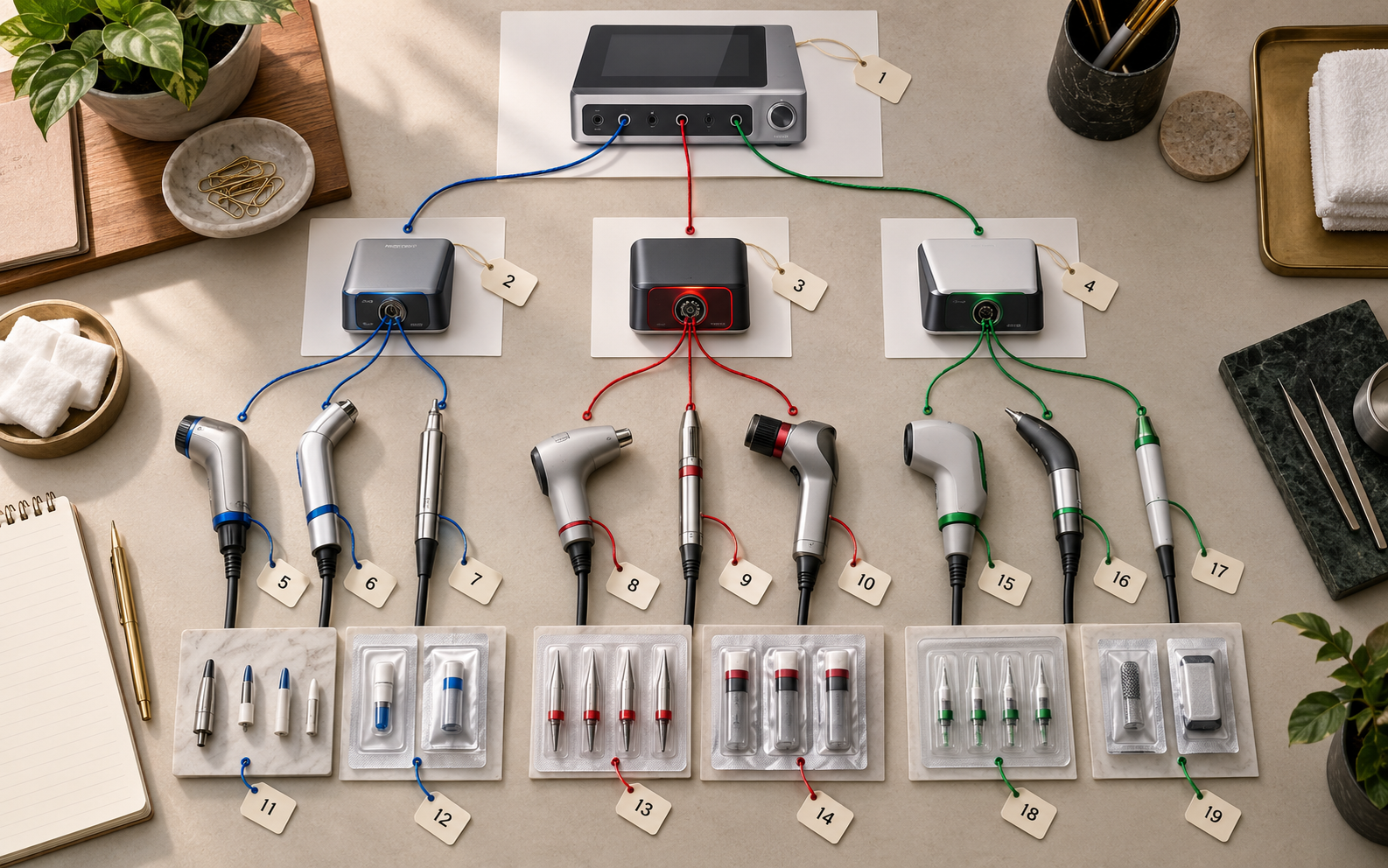
Map source, module, handpiece, tip and consumable as separate layers
Use one row for each physical or enabled item. A source may be integrated in the console, contained in a module or associated with a designated applicator; a handpiece may accept filters, tips, cartridges or another recurring item. Record the name used by the supplier, item code if supplied, parent relationship, connector or port reference, software enablement if stated, included/optional/recurring status and the exact evidence that supports the link.
Do not flatten the structure into a handpiece count. Two handpieces may draw from different sources, while one handpiece may use several filters or tips. A consumable may be specific to a revision, procedure set or connection path. The map should make one-to-many and conditional relationships visible, with “not supplied” or “pending” where the evidence stops. It should not invent wavelength, output, lifetime, procedure or compatibility data.
03 / Buying guide
Check quote, image, manual, label and configuration against the same map
Read each source as a separate record. The quote defines what the seller proposes commercially; product images show only the visible configuration and moment captured; the manual may cover several variants; the physical label identifies what its stated scope covers; and a configuration sheet should list the selected items. Put their dates and versions beside the component rows rather than treating a shared folder as consistent.
Flag extra and missing items both ways. An image may show a handpiece absent from the quote, while the quote may list a module that is not visible. A manual may describe optional functions, and a label may name only the console. None of those differences proves an error by itself, but each needs a written explanation before the buyer uses the file to compare price, publish a claim, plan training or prepare receiving.

04 / Buying guide
Treat compatibility and configuration changes as evidence questions
Appearance is not a compatibility test. A similar connector can carry different power, signal, cooling, control or safety relationships, and a handpiece from the same product family may depend on another console revision, module, firmware, calibration or consumable. FDA’s medical-device connector information documents why physical connectability can create the wrong connection in other device contexts; use that as a cautionary principle, not as a classification of beauty equipment.
When any base unit, source, module, handpiece, tip, consumable or software item changes, open an impact review. Check the quotation, configuration table, product images, manual, label, market records, training materials, parts references and support route. Record the old and proposed versions, source, responsible reviewer, affected decision and release status. A price update alone must not silently rewrite the technical baseline.
05 / Buying guide
Run a dependency check before accepting a changed configuration
A configuration change starts with a trigger: revised quote, substituted base unit, added or removed module, different handpiece, updated software, changed consumable, new image, manual revision or destination-market question. Record the trigger and compare the old and proposed maps. For every changed relationship, list the evidence that must be renewed and the commercial or operational decision waiting on it.
Review dependencies in a consistent order: identity and configuration, quotation, visible images, manual and label scope, destination-market documentation, training materials, parts and consumables, support routing, receiving checklist and public sales copy. Some rows may remain unchanged, but that decision should be explicit. A seller’s statement that an item is “the same” is a lead for the review, not a substitute for the exact relationship and version.
- Old and proposed component/version
- Triggering source and date
- Affected documents, images and commercial rows
- Training, parts, consumables and support impact
- Reviewer, open question and release status
06 / Buying guide
Send a bounded configuration request instead of a handpiece wish list
A concise request can state: “Please quote base model [code/version] for [market] and [quantity]. For each proposed source, module, handpiece, tip and consumable, identify the supplier item name/code, parent relationship, quantity, included/optional status and source document/version. Mark any compatibility or market question that remains unconfirmed.” Replace every bracket with the buyer’s actual project information.
Attach the buyer’s matrix and ask the supplier to mark deviations instead of returning only a brochure or combined price. Request the current product image, label reference and manual scope for the proposed configuration, then keep optional items on separate lines. This creates a comparison-ready response without asking the supplier to make undocumented regulatory, clinical, delivery or support promises.
Comparison visual
Multi-platform evidence: what each source can establish
Quotation
Commercially proposed base unit, named items, quantity and stated options
Physical identity, technical compatibility, manual scope or market authorization
Product image
Visible console, handpieces, accessories and condition at capture
Inclusions, internal source, function, revision or compatibility outside the frame
Manual or specification
Documented relationships and requirements within its named scope/version
That the quoted unit is the same variant or includes every described option
Label or identifier
Identity fields printed on the item within the label’s scope
Compatibility of an unlisted module, handpiece, tip or consumable
Written configuration map
The proposed relationship and open items when its source/version is controlled
Clinical suitability or regulatory status without the applicable evidence
Decision flow
Build and release a source-to-handpiece map
- 01
Baseline
Identify the base unit, version, source, market, owner and controlling quotation.
- 02
Map
Connect each source, module, handpiece, tip and consumable to written evidence.
- 03
Reconcile
Compare quote, images, manual, labels and configuration; log every mismatch.
- 04
Control
Propagate changes to training, parts, support and public material before release.
Practical table
Reusable multi-platform configuration matrix
Each checklist row shows every comparison field.
| Layer / field | What to record | Release question |
|---|---|---|
| Base unit | Exact model/source, hardware and software revision when supplied, market and quote version | Is this the same platform proposed commercially? |
| Source or generator | Supplier term, location/parent, evidence reference and applicable revision | Which module or handpiece relationship is documented? |
| Module | Item/code, parent source, connection or enablement, included/optional status | Is it in this bundle or only available separately? |
| Handpiece or applicator | Item/code, parent module/source, port, evidence, quantity and image reference | Is compatibility confirmed for this exact baseline? |
| Tip, filter or consumable | Parent handpiece, item/code, reusable/recurring status if supplied and replacement source | Is the relationship and version explicit? |
| Document consistency | Quote, image, manual, label and configuration versions with mismatches | Has each discrepancy received a written answer? |
| Change impact | Old/new version, affected quote, files, training, parts and support, owner and status | Can the revised configuration be released without an open blocker? |
Buyer FAQ
Frequently asked questions
What is a beauty device module and handpiece map?
It is a versioned record connecting the quoted base unit to each source, module, handpiece, tip or consumable. Every link carries its supplier source, applicable model or revision, inclusion status, target market, evidence, owner and unresolved question so procurement can compare and receive the exact proposed configuration.
Does a matching connector prove that a handpiece is compatible?
No. Physical fit or visual similarity does not establish the required power, signal, cooling, software, calibration, intended relationship or safety controls. Ask the responsible manufacturer or supplier to confirm the exact console, revision, module and handpiece relationship in writing before purchase, connection, training or parts planning.
How should quotation images and manuals be checked for a multi-platform device?
Record each file’s source, date and version, then compare its base-unit identity and visible or described components against the same configuration matrix. Log extra, missing or differently named items. A family manual or promotional image may cover options beyond the quoted bundle, so differences remain open until explained.
What changes when a module or handpiece is replaced in the offer?
Recheck every dependent record: quotation, configuration, images, manual, label, destination-market questions, training scope, parts references, consumables and support route. Keep the old and proposed versions, impact owner and written decision. Do not overwrite the baseline merely because the total price or exterior appearance stays similar.
Source notes
References and further reading
External references provide general regulatory or industry context; they do not establish approval of a listed product. Accessed 4 October 2026.
Request a quotation against one controlled platform map
Send the baseline model, proposed module and handpiece configuration, destination market and current quotation, image, manual and label versions. Ask that included, optional and unresolved relationships be answered line by line.
Request a quotation →