
TL;DR · Direct answer
The buying decision in brief
A professional beauty equipment demo checklist turns buyer questions into a bounded agenda, configuration record and follow-up log. Identify the exact model, included handpieces, software and documents before comparing what is shown. Separate live observations from written specifications, optional features and unanswered questions. Use the session to decide what evidence or clarification is needed next, rather than treating a demonstration as sample approval, operator training or proof of treatment results.
01 / Buying guide
Start with questions that can change the shortlist
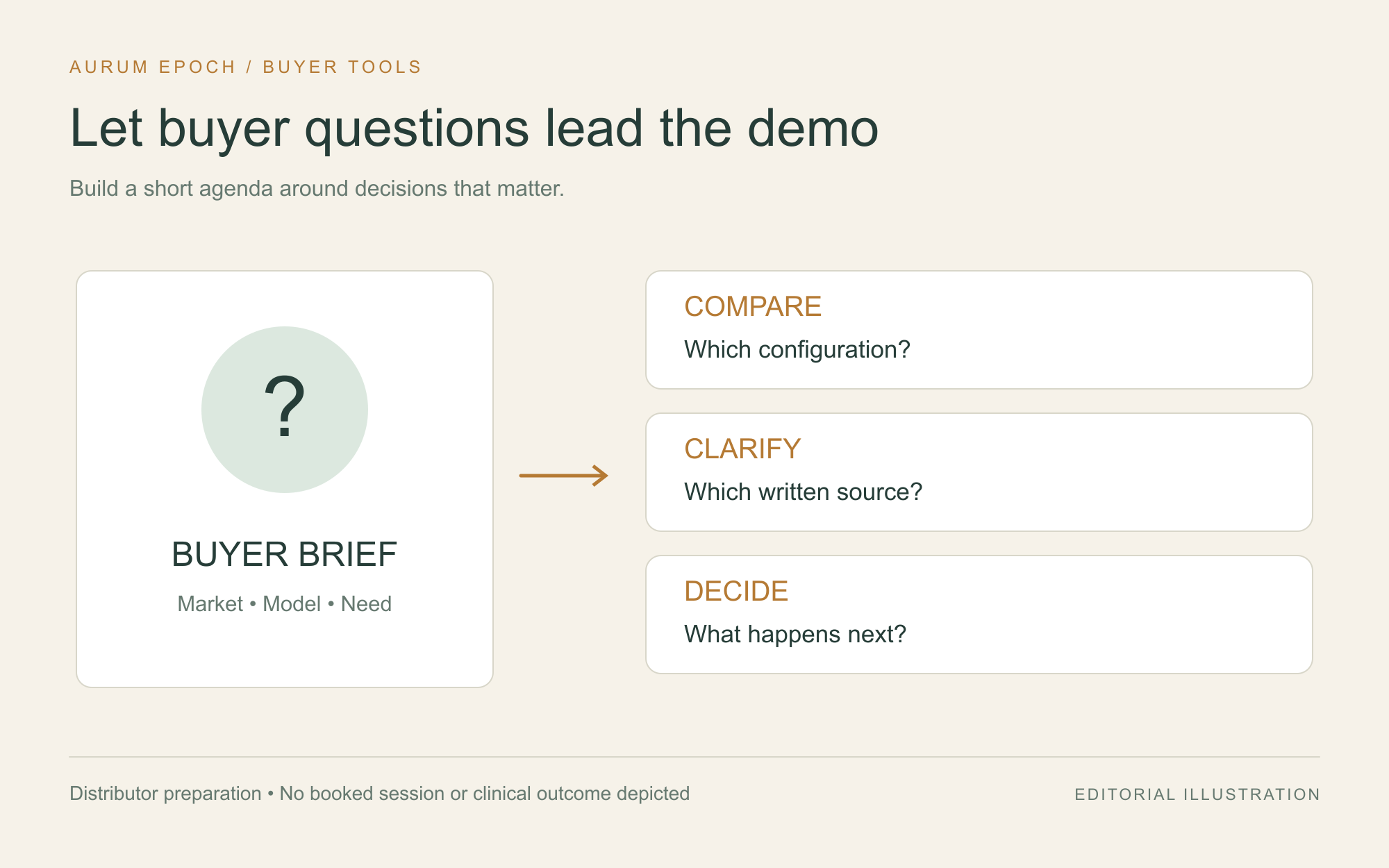
A distributor should arrive with a buyer brief, not just a request to see a machine. Identify the customer type, destination market, intended professional setting and candidate configuration. Then list the decisions the session should inform: whether a quoted accessory is included, which document describes the interface, how an available configuration differs from another, or what remains necessary for a focused quotation.
Prioritize questions that can be answered within the agreed format. Write down why each answer matters and what evidence would make it usable. A broad request to show every feature often produces an impressive tour with little comparable information. A question-led agenda lets the distributor explain which observations affected the shortlist and which purchasing questions still need a written response.
- Buyer role, market and intended professional setting
- Candidate model/configuration and comparison objective
- Question, required evidence and next purchasing decision
02 / Buying guide
Identify the equipment and files actually being shown
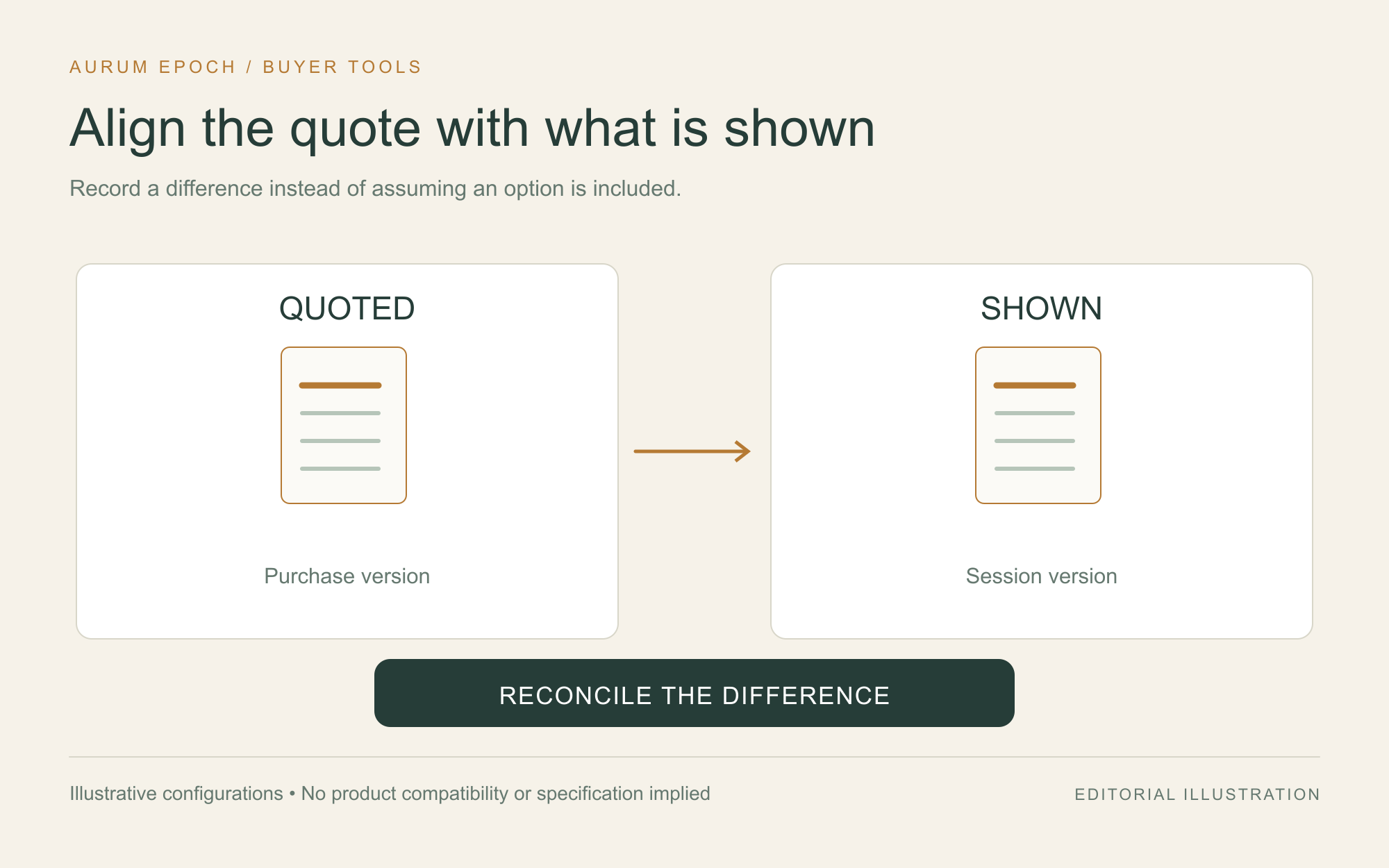
Ask for the exact model, handpieces, modules and available software or interface revision for the session. Keep that list beside the current quotation and document references. A demonstration can include an optional accessory, an upgraded version or another unit in the same family. Record these differences explicitly so the buyer can distinguish the proposed purchase from the demonstration setup.
Supplier demo pages commonly offer product selection and different formats, while product-family pages distinguish versions and accessories. Use that structure to prepare questions, not to transfer another brand’s claims to your shortlist. Match each proposed feature to the specific configuration and written source that covers it. Similar appearance, a familiar connector or a shared family name is not sufficient identification.
03 / Buying guide
Agree the session format, people and boundaries
Confirm whether the proposed session is an online walkthrough, a recorded-video discussion, a showroom meeting or another specifically agreed format. Note who presents, who records procurement questions and who can provide later technical or commercial answers. Check whether photography or recording is permitted before capturing material. Keep session logistics separate from any assumption that travel, samples, equipment loans or training are included.
Any practical operation requires the appropriate instructions, personnel, site conditions and applicable safety arrangements. The buyer preparation checklist is not an operating procedure. UK MHRA guidance addresses responsibility for manufacturer-loaned medical devices, and UKHSA guidance provides a separate laser-safety context. Neither establishes the classification of an Aurum Epoch model or permission to perform a clinical demonstration. Ask the responsible qualified team to confirm the applicable arrangements.
04 / Buying guide
Separate what you saw from what was stated
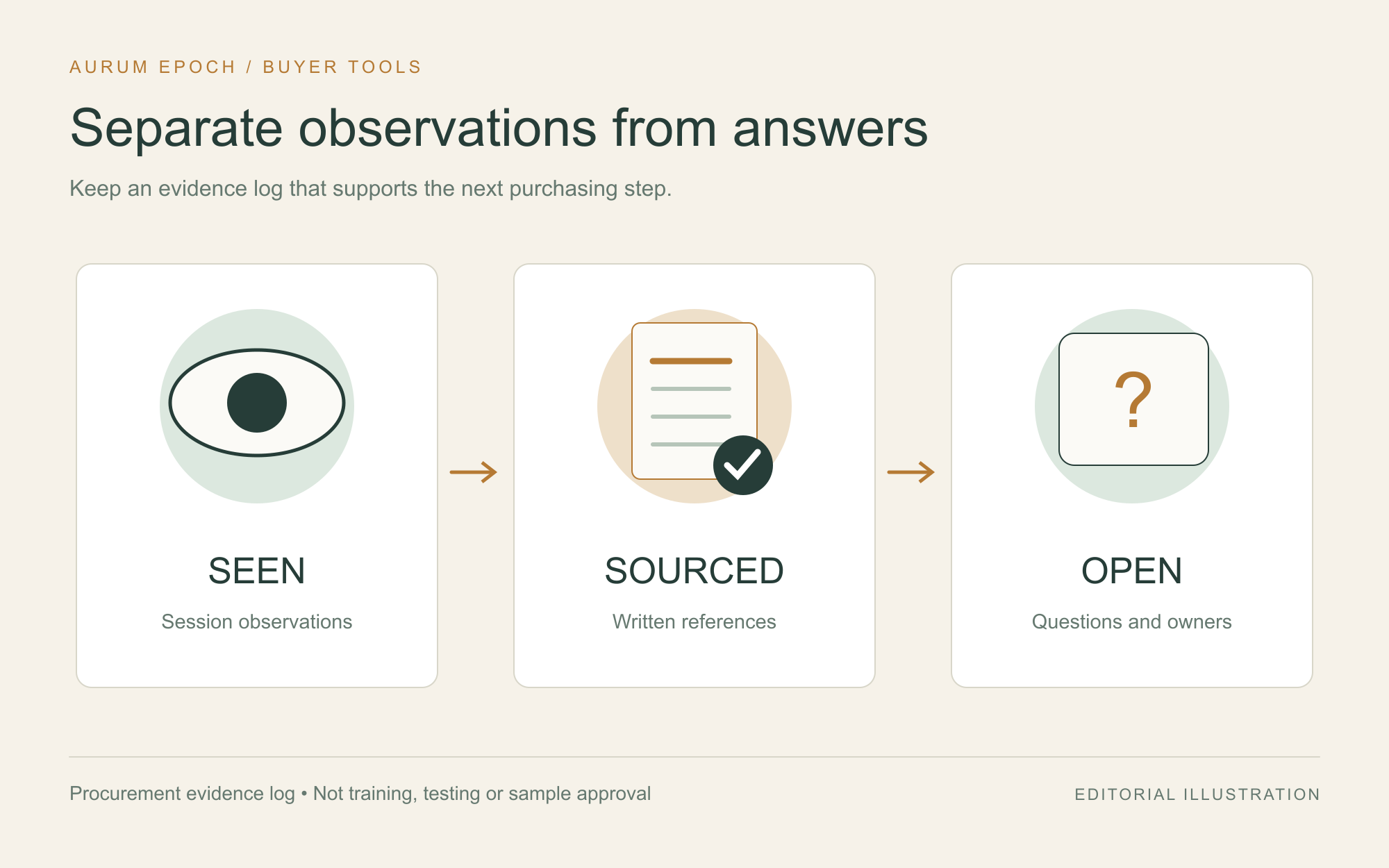
During the session, record the question, configuration shown, source or file version and a concise observation. Distinguish a live view from a prerecorded clip, a presenter’s explanation and a specification supplied in writing. If the image is too distant or a label is unreadable, request a suitable view or document rather than filling the gap from memory. Note any interruption or limitation that prevents an answer.
A visible interface or accessory can help frame a procurement question; it does not establish performance, compatibility or long-term outcomes. Avoid turning a convenient session into an improvised test. Keep patient information, personal details and internal documents out of shared comparison records. Where authorized recordings are retained, identify the permitted audience and source so another salesperson does not reuse them as a different model’s evidence.
05 / Buying guide
Pause the comparison when its basis changes
If the model, handpiece, software or documentation differs from the planned baseline, identify the affected questions and decide whether they can still be answered. Record the difference and request a scoped follow-up. Do not silently replace the quoted configuration with the one that happened to be available. Use awaiting evidence, configuration mismatch and outside agreed scope as useful findings, each with a named response owner.
Review commercial questions separately: included items, exclusions, requested quantity, documentation, branding and support scope belong in the written offer. Observing an accessory in a session does not add it to the quotation. A verbal answer about availability is also different from a written commitment for the requested market and purchase. Link the actual response to the question before changing the comparison record.
06 / Buying guide
Finish with a follow-up record and a clear next step
After the session, distribute a short record containing the date, participants and roles, model/configuration seen, documents used, observations, open questions and response owners. Ask the responsible parties to correct misunderstandings in writing. Preserve the session record if a revised offer arrives, and link the new version instead of rewriting what was shown. Set the buyer’s next review point without inventing a supplier response-time guarantee.
For each candidate, decide whether to continue comparison, seek specific documents, request a model-specific quotation or hold the option pending evidence. Keep this decision separate from sample sign-off, an order approval and operator handover. The distributor can then explain the next step with a concrete reason and a traceable question, rather than relying on how persuasive the presentation felt.
Comparison visual
What can the session answer, and what still needs a source?
Which configuration is being compared?
Model, interface and accessories actually shown
Identify differences from the quotation and name the applicable file version
Is that accessory included?
A handpiece is visible in the session
Check the itemized written offer and any separately quoted options
Can this recording support my buyer discussion?
A live view or prerecorded clip is available
Confirm identity, date/context and permission for the intended audience
Does this establish operational readiness?
A presenter explains or shows a workflow
Separate required safety, site, operator and handover checks
What happens after the meeting?
Questions and limitations have been noted
Assign answers and choose the next evidence-led purchasing step
Decision flow
From buyer brief to an evidence-led next step
- 01
Define
Write the buyer questions, market and comparison objective.
- 02
Align
Identify the session model, configuration and document versions.
- 03
Confirm
Agree format, people, permitted recording and applicable boundaries.
- 04
Observe
Separate live observations, written sources and open questions.
- 05
Follow up
Assign answers and update the shortlist with a dated decision.
Practical table
Reusable distributor demo preparation and follow-up sheet
Each checklist row shows every comparison field.
| Record field | What to enter | Decision check |
|---|---|---|
| Buyer objective | Buyer type, market, professional setting and purchasing question | What could change the shortlist? |
| Configuration | Candidate model, quoted/shown items and optional accessories | Is the compared scope the same? |
| Versions | Software/interface and document references where supplied | Which source describes the shown setup? |
| Session plan | Format, date, presenter, buyer recorder and suitable conditions | Are people and scope agreed? |
| Observation | Question, what was actually seen, limitation and authorized evidence reference | Is this observation or a statement? |
| Follow-up | Open question, response owner, required file and review date | What precise answer is missing? |
| Buyer decision | Continue, request documents/quotation or hold; reason and date | Is the next action justified by the record? |
Buyer FAQ
Frequently asked questions
What should a distributor prepare for a remote demonstration?
Send a short buyer brief, model/configuration list and prioritized procurement questions. Agree the format and ask which identifiers, accessories and documents can be shown clearly. Record what requires a later written answer.
What if the demonstrated configuration differs from the quote?
Record the difference against the quotation version and identify affected questions. Request a written explanation or a session covering the intended scope before treating the options as comparable.
Can I treat a successful demonstration as training or sample approval?
Keep those decisions separate. A purchasing discussion does not establish operator competence, sample acceptance or release for use. Each needs its own agreed scope, responsible people and applicable records.
How can I compare equipment after several demonstrations?
Use the same buyer-question matrix for each candidate, while keeping each model, version and evidence source distinct. Compare answered questions and unresolved gaps, then record the reason for the next purchasing step.
Source notes
References and further reading
External references provide general regulatory or industry context; they do not establish approval of a listed product. Accessed 1 November 2026.
Bring your buyer questions to a focused equipment request
Share the target market, candidate model and configuration, buyer questions, comparison objectives and existing documents. Include the unresolved points you want the commercial or technical response to address.
Request a quotation →