
TL;DR · Direct answer
The buying decision in brief
Compare beauty equipment support plans using the same installed models, regions, contract period and incident scenarios. Ask each provider to identify covered work, who owns each handoff, which clock governs first response and what the plan actually commits to restore or resolve. Include fixed fees, chargeable exclusions and approval rules. Record each answer against the written offer before choosing which plans to shortlist.
01 / Buying guide
Give providers the same installed-fleet scenario
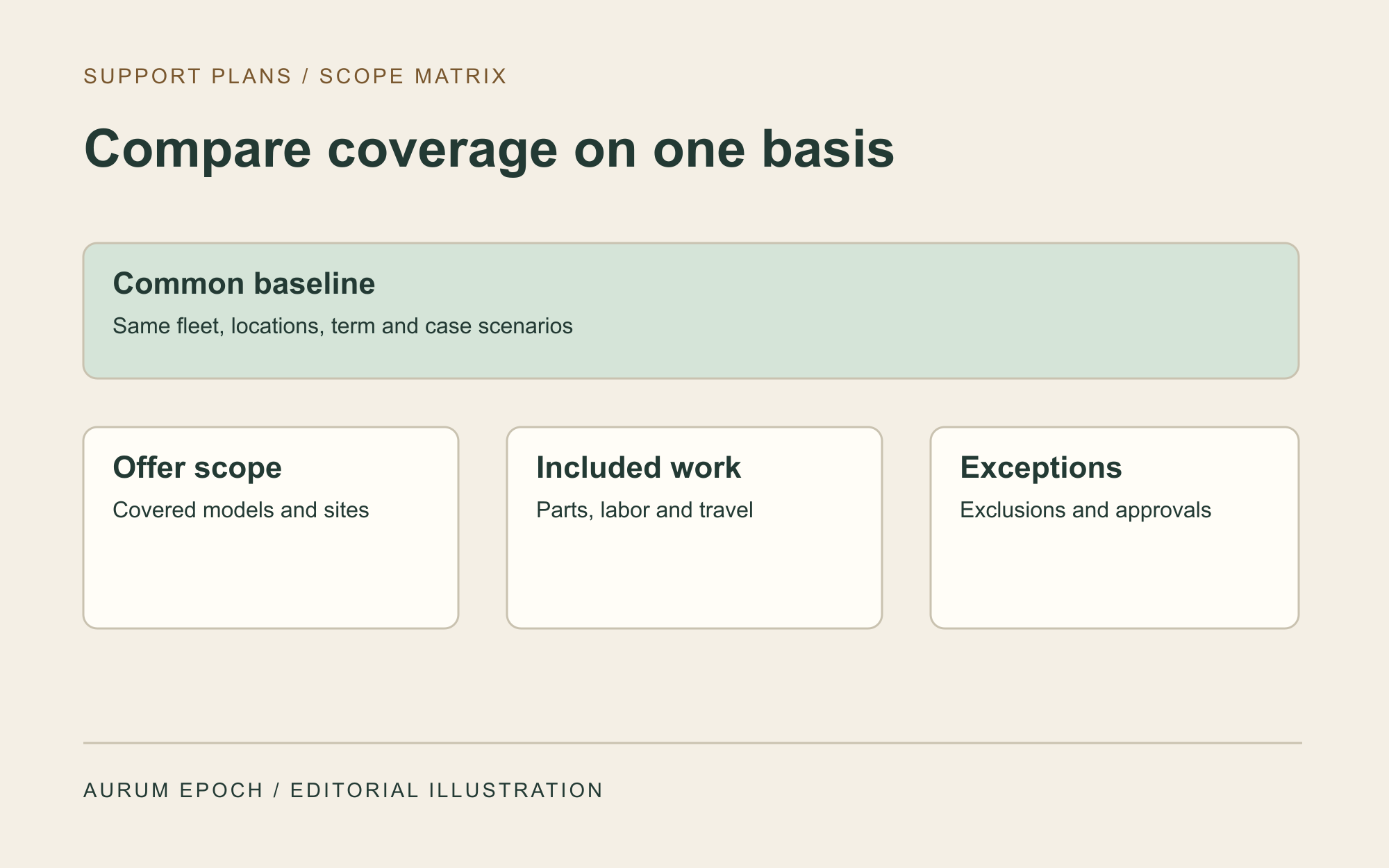
Set a single comparison scope before reading prices. List the device models and configurations, quantities, installation locations, operating hours and any existing coverage. Record the requested term, start date, currency and treatment of taxes. Where eligibility depends on age, condition or a prior inspection, keep the provider’s written requirement next to the affected devices. That makes partial eligibility visible before a flat fee reaches the shortlist.
Ask each provider to confirm which sites and models it can cover and whether remote and on-site service have different geographic limits. Identify where a distributor or local subcontractor must take over. Mark devices outside the offer separately so that a less expensive partial plan stays distinguishable from a fully scoped offer.
02 / Buying guide
Assign a channel and an owner to each incident
Define example incidents in operational terms, such as a device that cannot be used, a unit that can continue with reduced functionality, or a routine service question. Ask providers to map the same cases to their written priority categories. Record who can open a case, the approved contact channel, support hours, required information and the handoff from intake to the team authorized to act.
03 / Buying guide
Check who takes over when a case escalates
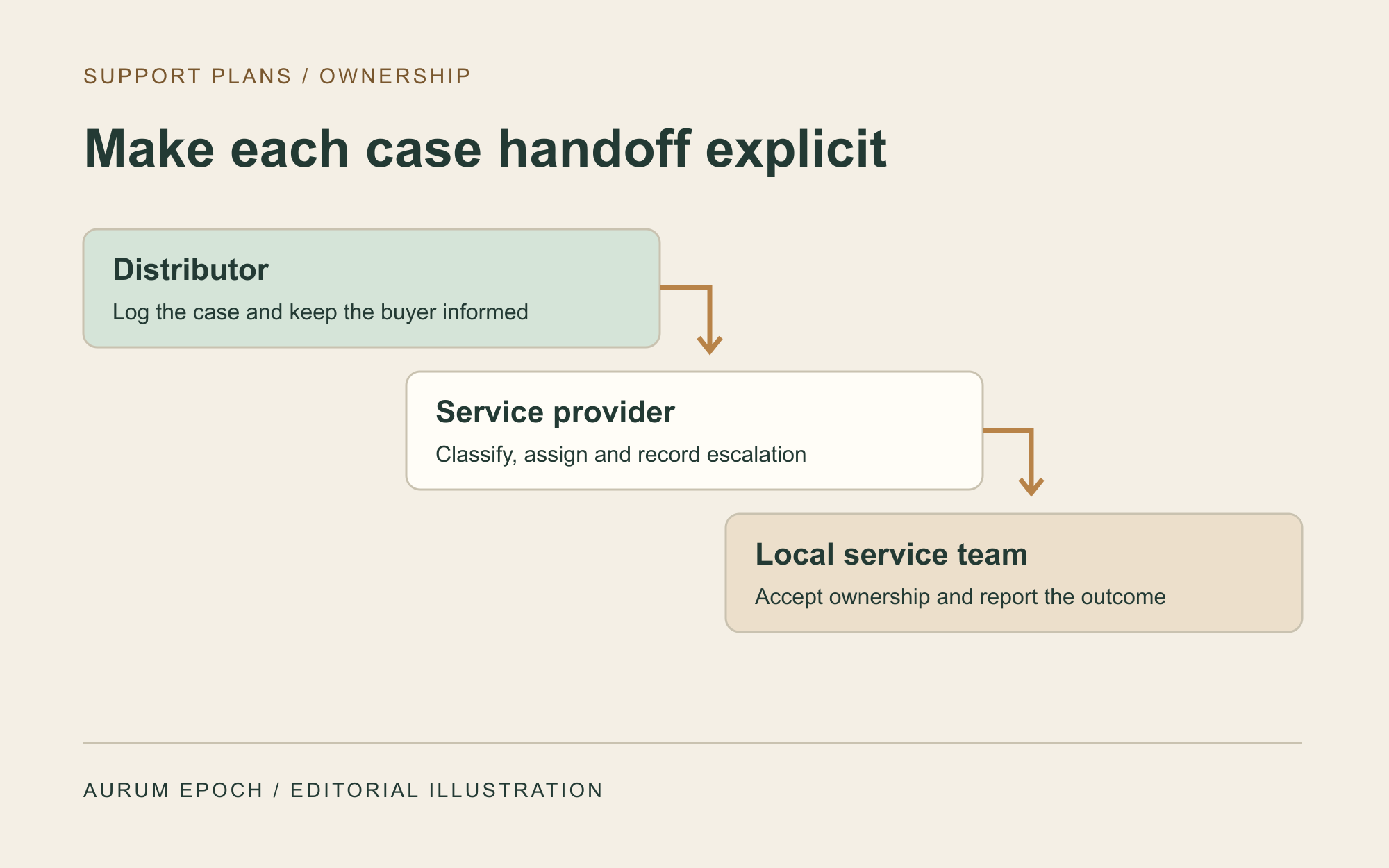
Trace what the distributor should do when the case moves to another team or country. Identify the current owner, who communicates with the customer, when to escalate and who records closure. For issues that require separate safety handling, keep the applicable manufacturer and local procedures distinct from the commercial service comparison.
04 / Buying guide
Separate first response, restoration and resolution
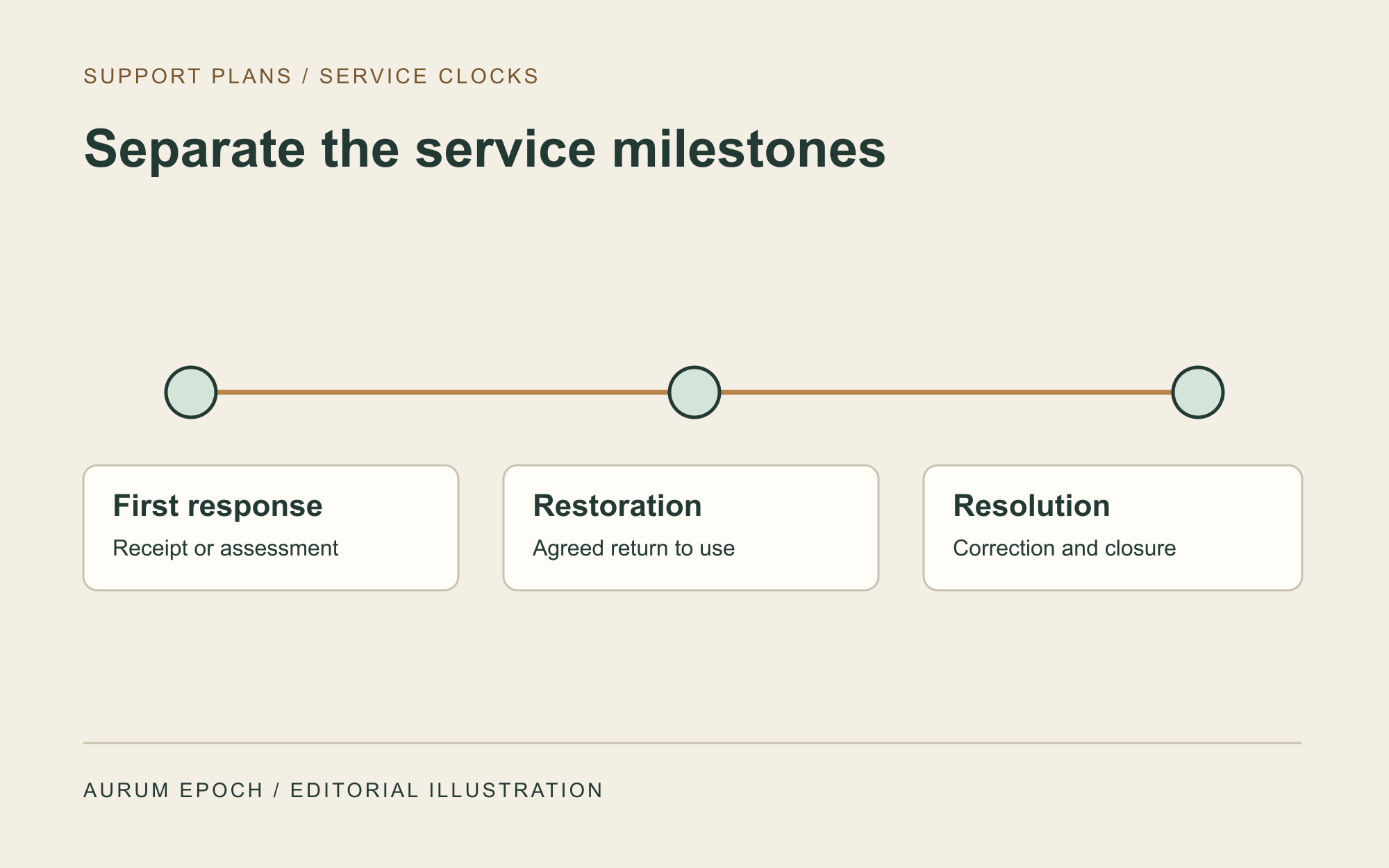
A first response can acknowledge a request or begin assessment. Ask which one the provider measures. Restoration may mean a documented workaround or return to operation under agreed conditions. Resolution can require a permanent correction and acceptance. For each commitment, record the start, stop and pause conditions, time zone, business hours and reporting method.
Ask providers to distinguish a target from a contractual commitment. Use a scenario that starts outside local business hours to expose differences in the clock. Where a target depends on parts availability, site access or approval for chargeable work, record the dependency next to the target. If the proposal specifies only first response, leave restoration and resolution open for clarification.
05 / Buying guide
Price the same cases across offers
Compare the base fee and then price the same case types under each offer. Check remote assessment, labor, travel, replacement parts, freight and any after-hours charges. Separate included work, excluded work and optional work requiring approval. Show quoted figures and assumptions in separate cells. Ask how a changed equipment count, new location or renewal would affect the written offer.
06 / Buying guide
Document the shortlist and next decisions
Keep the proposal version, named responsibility, exclusions and unresolved questions with the shortlist. Flag a gap that changes coverage, cost or the ability to hand over a case as an item to resolve before approval. Use the agreed case process to brief the distributor team and retain the written source so later service records can be checked against the same terms.
For example, two proposals may both include remote assessment, while only one includes an on-site visit for the same case. Mark that distinction in the case comparison and ask who can approve travel or an additional charge. Record the decision and the proposal revision so the person opening the case can tell which work is included and who must authorize the rest.
Comparison visual
Compare two written support offers on the same basis
Eligibility
Covered model, configuration, site and contract dates
Omitted device or location
Incident handling
Priority, channel, intake hours and case owner
Unclear escalation or handoff
Time commitments
Separate definitions for response, restoration and resolution
Unstated clock, pauses or dependencies
Fees and exclusions
Base fee, chargeable items and authorization threshold
Cost left outside the comparison
Written evidence
Proposal revision, service schedule and reporting method
Claim unsupported by the written offer
Decision flow
Build a distributor support-plan shortlist
- 01
Normalize the scope
Use one fleet list, service period and commercial basis.
- 02
Map identical incidents
Compare case priority, intake and handoff by scenario.
- 03
Check clocks and cost
Separate response from resolution and price included and excluded work.
- 04
Resolve written gaps
Request revisions and identify who can accept any exclusions.
- 05
Record the shortlist
Retain the selected offers, reasons, open items and handover owner.
Practical table
Reusable support-plan decision record
Each checklist row shows every comparison field.
| Field | What to capture | Source to verify |
|---|---|---|
| Fleet and region | Device, configuration, site and existing coverage | Asset list and eligibility schedule |
| Case scenario | Impact, priority and reporting channel | Written incident classification |
| Handoff | Intake, assignment, escalation and closure owners | Service workflow and contact schedule |
| Commitments | Clock, milestone, hours, pauses and measurement | Service schedule and reporting terms |
| Cost and limits | Fixed fee, chargeable work and exclusions | Dated commercial offer |
| Shortlist decision | Reviewer, reason, unresolved terms and due date | Comparison record and written clarifications |
Buyer FAQ
Frequently asked questions
Is a quick first response the same as a repair commitment?
Check the exact milestone. A reply may acknowledge the case while a restoration or resolution commitment describes a later outcome with its own conditions and clock.
Can one plan cover different configurations of the same model?
Ask the provider to list each eligible configuration and location in writing. Keep uncovered configurations and conditional eligibility visible in the comparison.
How do we compare a fixed-fee plan with pay-per-case service?
Use the same period and set of case scenarios. Show the base fee and case charges separately, and record assumptions and exclusions for both offers.
Source notes
References and further reading
External references provide general regulatory or industry context; they do not establish approval of a listed product. Accessed 7 November 2026.
Share the support terms you need to compare
Include the markets, equipment models and configurations, and the written coverage, cost or handover terms you want clarified.
Request a quotation →